
Enterprises choose IZO™+ Multi Cloud Connect over public-internet connectivity to AWS, Azure, GCP, Oracle, IBM Cloud and other cloud service providers for below reasons:
- Predictable SLA-backed performance,
- Private dedicated connectivity,
- Bandwidth flexibility from 50 Mbps to 25 Gbps,
- Multi-region and multi-cloud reach over a single backbone,
- Cost optimisation
- Consolidated operations under one contract.

1. Predictable performance, backed by SLA
Claim: IZO™+ Multi Cloud Connect delivers consistent latency, jitter, and packet loss across the Tata Communications backbone, with contractual service-level guarantees.
Evidence: The backbone is MPLS-based, with a single Class of Service applied to Multi Cloud Connect traffic. Performance is measured end-to-end between the customer site and the cloud interconnect, and reported monthly through the TCx Portal.
What this enables: Real-time applications (voice, video, trading systems) and latency-sensitive workloads (database replication, transactional systems) become viable in cloud architectures, with predictable cost modelling rather than variable internet performance.
2. Private, dedicated connectivity
Claim: Traffic between your network and the cloud provider never traverses the public internet.
Evidence: The backbone is a private MPLS network. Cloud-side interconnects between Tata Communications PE routers and the cloud provider’s edge are dedicated. Traffic is isolated end-to-end using VRFs at the routing layer and VLANs at the link layer.
What this enables: Reduced exposure to internet-based threats including DDoS, easier compliance with data-sovereignty and residency requirements (especially in regulated industries and jurisdictions with strict data residency rules), and a smaller overall security perimeter.
3. Bandwidth flexibility
Claim: IZO™+ Multi Cloud Connect supports bandwidth from 50 Mbps to 25 Gbps per connection, with multiple options for upgrading as workloads grow.
Evidence: AWS Hosted Connection slabs include 50, 100, 200, 300, 400 and 500 Mbps for standard tiers, and 1, 2, 5, 10 and 25 Gbps for high-capacity tiers. Azure ExpressRoute supports 50 Mbps to 10 Gbps. Bandwidth can be added on Tata Communications-managed direct interconnects without rebuilding the underlying connection.
What this enables: Right-size connectivity for actual usage rather than over-provisioning, and scale up as production workloads grow without re-architecting the underlay or renegotiating the contract.
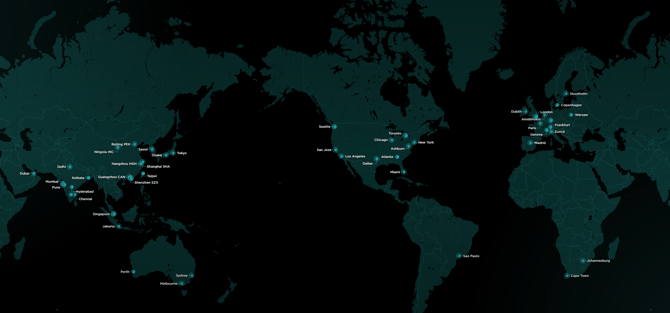
4. Multi-region and multi-cloud reach
Claim: IZO™+ Multi Cloud Connect connects your global sites to multiple clouds over a single backbone, with the four standard L3 VPN topologies supported.
Evidence: Tata Communications’ MPLS backbone reaches points of presence in every major geography. The four supported deployment scenarios (full mesh, hub-and-spoke, cloud-to-cloud and selected sites) cover the realistic enterprise patterns. A single IZO™+ Multi Cloud Connect service can extend to multiple cloud providers and multiple regions per provider.
What this enables: One enterprise architecture can serve branches and data centres across geographies, reach multiple cloud regions and span AWS, Azure and Google Cloud without duplicating cloud-side terminations or running separate vendor contracts per cloud.
5. Consolidated operations
Claim: IZO™+ Multi Cloud Connect brings the network, the cloud-side interconnect and ongoing management together as a single service, operated from one portal.
Evidence: Sign-up, ordering, provisioning, monitoring, change-management, billing and decommissioning happen through the TCx Portal, with unified service-request and change-request workflows and a single monthly invoice.
What this enables: A single operational view and a single support contact for the end-to-end service. Fewer moving parts to manage day to day means faster changes, clearer accountability when something needs attention, and less effort spent coordinating across separate carrier, colocation and cloud-interconnect relationships. And because ordering and changes are self-serve and on-demand, new connections and bandwidth changes can be turned up quickly as needs evolve.

6. Cost optimisation
Claim: IZO™+ Multi Cloud Connect can lower the total cost of cloud connectivity, through reduced reliance on public-internet egress, private cloud-to-cloud paths, right-sized bandwidth and consolidated security.
Evidence: Private connectivity moves traffic off per-gigabyte public-internet egress paths. Cloud-to-cloud connectivity keeps inter-cloud traffic on the backbone, avoiding the “double egress” pattern where two providers each bill egress on the same flow. Bandwidth tiers let you size to actual usage instead of over-provisioning, and connecting clouds privately lets you centralise security and landing zones rather than duplicating them per cloud.
What this enables: Lower and more predictable connectivity spend, fewer duplicated security stacks, and the ability to scale bandwidth with demand rather than paying for peak capacity year-round.
7. Resilience and business continuity
Claim: IZO™+ Multi Cloud Connect can be built with diverse, dual paths so that a link or node failure does not take the connection down.
Evidence: Connections are offered in Standard, High and Maximum resiliency tiers, from dual diverse paths within a metro to paths that diverge across regions or metros. Fast failure detection and BGP path control (active/backup weighting) move traffic to a healthy path automatically.
What this enables: Higher availability for business-critical workloads and a foundation for disaster recovery, so cloud access keeps running through link, node or site failures.