Digital and data sovereignty have been discussed for years, but their implementation has varied by region. For some, sovereignty means storing data within national borders. Recent geopolitical events have brought it into sharper focus.
Consider an energy company operating in India whose access to their services and its own company data running in a hyperscaler environment was suspended in July 2025 following a regional sanction. While access was subsequently restored, the incident is ominous. Whatever the merits of the restriction, it showed how decisions about access to critical technologies can impact enterprises, critical infrastructures and government agencies.
Geopolitical exposure is not limited to hyperscalers. After a tech giant acquired a prominent provider in the cloud supply chain, changes to its terms left many service providers stranded. This illustrates one of the many dependencies within regional cloud services. A provider could own its facilities and servers while depending on another company for the right to continue delivering services.
These cases are one of the few examples of why technology leaders in government and regulated industries need to take sovereignty seriously. It also raises the important sovereignty question of who holds the ‘kill-switch’.
Defining sovereignty
While Data residency is the foundation for Sovereignty, a complete definition must also cover the applicable laws, the authority to operate and the technology on which the service depends. We see sovereignty as four layers.
First, data residency establishes the physical boundary. It covers where application data is stored and processed, and where backups, logs and relevant metadata reside. The architecture must reflect this boundary, and operations must verify it.
Second, jurisdictional sovereignty addresses the legal boundary. Which laws apply to the provider and its delivery chain? Who can compel access, restrict service or enforce a decision? Corporate structure, contracts and upstream dependencies all matter.
Third, operational sovereignty addresses who runs the environment. It includes authority over privileged access, encryption keys, configuration changes, incident response and recovery. Teams need the skills, credentials and tools to act, with clear customer oversight.
Fourth, technology sovereignty addresses the ability to sustain and manage the underlying stack. Can the operator maintain the platform, change support arrangements or migrate workloads if a supplier withdraws access or changes commercial terms?
Together, these four layers provide a comprehensive definition of sovereignty and a basis for designing and managing the right solution.
How India is approaching sovereignty
India is building a strong regulatory framework for trusted cloud adoption, with safeguards across multiple layers proportionate to workload sensitivity. MeitY’s recent advisory on data classification and the selection of cloud providers is a step forward:
- Sensitive Category A systems, such as Aadhaar, PAN and UPI, are directed to government infrastructure or sovereign cloud providers as and when notified.
- Category B also permits MeitY-empanelled public and virtual private clouds.
- Top Secret and Secret workloads remain outside cloud under the NISPG position cited, while departments retain discretion over classification.
In regulated industries such as BFSI, RBI’s outsourcing directions emphasise institutional accountability, enforceable oversight, audit access, continuity and exit planning. SEBI’s cloud framework adds explicit requirements for provider selection, data localisation, ownership and security.
Together, these approaches point to a clear direction: cloud adoption extends from data residency to demonstrable control, resilience and regulatory assurance. Requirements vary by sector and workload, rather than through a single sovereignty label.
Tata Communications Cloud
Today, sovereignty is often presented as a compromise. Organisations value the breadth, familiarity and scale of hyperscalers. On the other side, domestic cloud providers considered sovereign are built around manual processes that can leave customers managing the complexity. Our sovereign cloud platform is designed from the ground up to address this with the capabilities of a modern cloud platform.
Tata Communications serves 300+ customers, including 20+ ministries and public agencies, across five Indian and three international regions. Our cloud provides Infrastructure as a Service, including compute, storage, networking and security, specialised SAP/Oracle clouds; Platform as a Service offerings such as Kubernetes, DBaaS and DevOps; and AI Cloud. Our Government Cloud, which is purpose-built for government ministries, nodal agencies and PSUs, is gaining significant traction as a certified platform for hosting sensitive workloads through comprehensive infrastructure and platform services.
As a managed cloud provider, we work with our customers across their journey, from solution design and delivery to managed operations under SLAs.
"Our key value proposition is our ability to provide a comprehensive zero trust security architecture, simpler experience for builders and users, and AI-enabled management."
How are we sovereign?
At Tata Communications, we are building a comprehensive platform to deliver sovereign outcomes for customers through three key pillars: Comply, Control and Continue.
Comply gives customers confidence that their cloud meets applicable requirements for data location, legal accountability and assurance. Our certifications and independent assessments cover operational excellence and continuity, security and privacy, and industry-specific requirements, including BFSI and government cloud. Together, they provide a foundation for our cloud services.
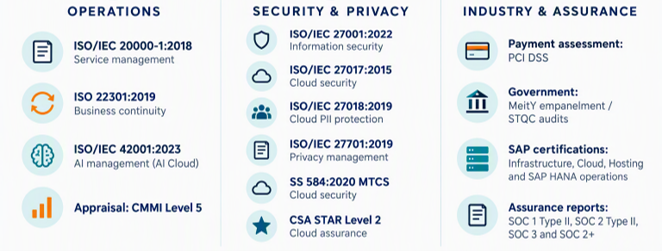
Compliance also means supporting our customers’ compliance obligations through access to relevant logs, audit evidence and reporting aligned with relevant regulatory requirements.
Control gives customers authority over their data, platform and the decisions that govern it and ensures that the ‘Kill-switch’ is within the control of the customer. Our sovereign cloud approach combines jurisdiction, in-country control-plane operations and locally governed administration, with clear accountability for access, platform changes and incident response. Flexible security controls support identity and role-based access, bring your own key, network isolation, encryption and audit trails. We have assessed legal and technology dependencies across the delivery chain so that control extends to how the service is operated and secured.
Continue means keeping services usable and recoverable regardless of failures or supplier dependencies. We have comprehensively evaluated our cloud solution, prioritising open architecture and open-source technologies. Our adoption of a KVM-based hypervisor, alongside open platform components such as Kubernetes and other database services, strengthens platform independence and continuity. To support this approach, we are committed to maintaining skills, validating releases, securing software supply chains and sustaining support. Cyber resilience adds another dimension of continuity: immutable backups protect retained recovery copies from alteration or deletion, while geo-resilient backup and disaster recovery options support restoration. We are strengthening recovery monitoring and testing to validate that data and services can be restored against agreed recovery objectives.
Ultimately, sovereignty should provide confidence to enterprises to move beyond compliance to control to continuity. That is what we are building at Tata Communications.