Booking an appointment should be simple. A patient wants to see a doctor. A car owner needs a service slot. A hotel guest wants to reserve a table or book an experience. The customer’s expectation is straightforward: understand what I need, show me what is available, and confirm it.
Behind that simple interaction, however, an enterprise may need to coordinate identity checks, eligibility, policies, staff availability, locations, resources, calendars, reminders and follow-ups across several systems.
That gap between customer simplicity and enterprise complexity is where booking journeys often fail.
Customers find themselves asking: “Why do I need to repeat my details?” or, more damagingly, “Is my appointment actually confirmed?”
These are not minor inconveniences. At scale, they create abandoned bookings, unused capacity, additional calls, manual work, and lost revenue. This is why appointment booking is becoming an important proving ground for enterprise AI. The opportunity is not merely to automate scheduling. It is to make the complexity behind the booking disappear.
A booking request is a request for action
There is a critical distinction between answering a customer and completing what they need.
A chatbot can provide clinic hours. An IVR can route someone to a service department. A website can display available dates. But when a customer says, “I need an appointment next Tuesday afternoon,” the enterprise must act.
It may need to identify the customer, understand the required service, check eligibility, apply business rules, find the right resource, reserve capacity, update systems, and send a confirmation.
In other words, appointments are where customer intent becomes enterprise work.
Success should therefore be measured not simply by whether an interaction was answered or contained, but by whether the customer achieved the outcome they came for.
The hidden cost of booking friction
Booking failures rarely arrive as one dramatic breakdown. They accumulate through many small moments: a patient gives up while on hold, a vehicle owner repeats information to multiple people, a guest finds a reservation but receives no confirmation, or a cancelled slot is never offered to another customer.
For CX leaders, this increases customer effort. For operations teams, it creates calls and manual coordination. For businesses, it means underused capacity and demand that disappears before becoming revenue.
Appointment capacity is perishable. Yesterday’s unused consultation slot, workshop bay, or restaurant table cannot be sold tomorrow.
A 2025 Frontiers in Digital Health study found that online appointment scheduling helped healthcare providers use resources more efficiently through 24/7 booking and reduced manual coordination. Online-booked appointments had a median no-show rate of 1.8%, compared with 5.9% for offline bookings.

Why point automation is not enough
Most large organisations already have booking applications, calendars, IVRs, forms, reminder systems, and conversational AI. The problem is that these tools frequently optimise individual steps rather than the complete journey.
A voice bot may capture a request but fail to apply an eligibility rule. A scheduling application may find a slot without understanding the customer’s preferences. A reminder may say an appointment is tomorrow but be unable to respond when the customer asks to move it to Friday.
Someone must still connect the dots manually.
As McKinsey observed in 2025, the next phase is not simply about automating tasks. It is about redesigning how work gets done. The harder problem is not the conversation itself. It is what happens after the customer speaks.
From interaction to orchestration
Imagine a customer saying, “I need to get my car serviced next week. Saturday morning would be ideal.”
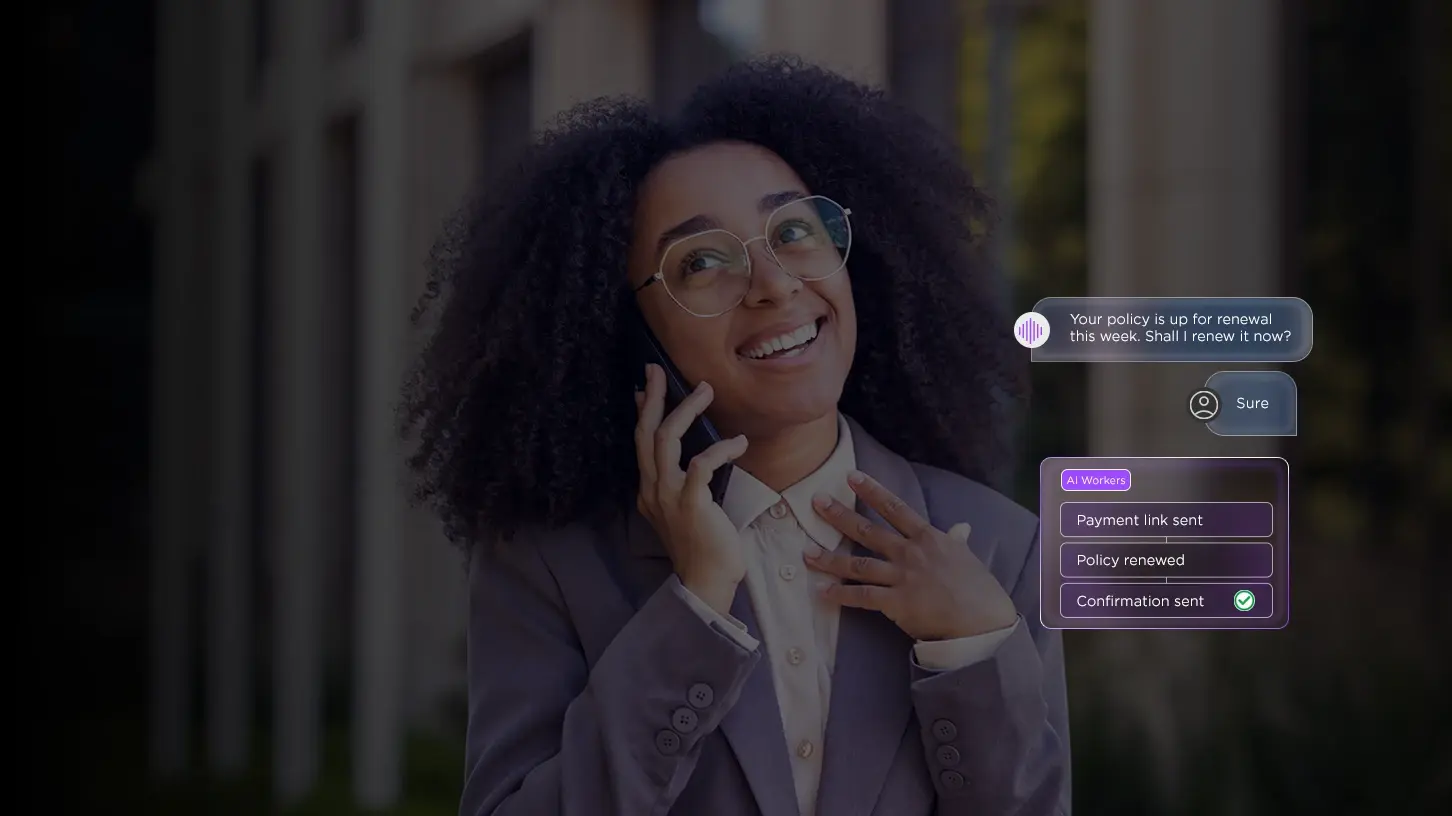
Voice AI can understand the request, clarify the vehicle or service details, and ask necessary questions. On the backend, AI Workers can check customer and vehicle records, apply service rules, review workshop availability, identify suitable slots, create the booking, update systems, and trigger confirmations and reminders.
Put simply: Voice AI handles the conversation. AI Workers handle the work.
At enterprise scale, an AI Operating System can connect systems, workflows, permissions, policies, auditability, and human checkpoints. A Context Graph can provide shared context, including who the customer is, what they want, what happened previously, which policies apply, and which resources are available.
"The result is fundamentally different. Instead of receiving an answer and inheriting the work needed to complete the process, the customer receives an outcome."
What a connected journey looks like
A connected appointment journey can remain simple for the customer:
- Understand intent: Let the customer explain what they need through voice, web, IVR, or messaging.
- Verify what matters: Complete identity, eligibility, consent, or policy checks without requesting information the organisation already holds.
- Find the right option: Match availability across locations, people, resources, and customer preferences.
- Complete the booking: Create or change the appointment across relevant systems.
- Maintain continuity: Preserve context through confirmations, reminders, follow-ups, rescheduling, and channel changes.
A strong booking experience should survive changes in timing, location, channel, or intent without forcing the customer to start again.
The same DNA across industries
In healthcare, orchestration can improve access and help providers use scarce clinical capacity more effectively. In automotive, it can connect customers, dealerships, workshops, service advisers, technicians, and vehicle records.
In hospitality, the economics are immediate because a table or activity slot loses its value once the moment passes. Yet automation must be balanced with hospitality itself. SiteMinder research involving more than 12,000 travellers found that 78% wanted to use AI during their accommodation journey, while only 12% wanted machines to manage every hotel function.
This suggests a more effective model: selective autonomy. Let AI manage routine coordination and execution, while people handle situations where judgment, empathy, or service recovery adds genuine value. The same principle can apply to utilities, telecom, banking, insurance, inspections, consultations, and other appointment-led services.
The booking is not the outcome
The greatest opportunity may not be replacing people but stopping organisations from using skilled employees as the integration layer between disconnected systems.
People should focus on exceptions, complex decisions, sensitive conversations, and moments where trust matters, rather than copying information, searching calendars, or reconstructing context the enterprise already possesses.
The next generation of appointment experiences will be judged by tangible outcomes: Did the customer get the right appointment? Was it confirmed? Did every system update correctly? Could the booking be changed without starting again? Did a person step in when genuinely needed?
This is the thinking behind Tata Communications Commotion, which combines Voice AI, AI Workers, a Context Graph, and Journey Orchestration to connect conversations with enterprise action. Enterprises can explore how Commotion supports a connected, always-on appointment journey.
Customers should not need to understand how an enterprise is organised to get something done. The promise of AI in appointment booking is not simply a smarter interface. It is making the machinery behind that interface disappear, so customers receive not another process to navigate, but a confirmed outcome. Exactly what they expected.